Celebrating Jericho 200
2025 marks 200 years since the meadows bounded by the Oxford Canal, Walton Well, Walton Street, and Worcester College began to be transformed into the residential suburbs of Jericho, and subsequently Walton Manor:
a) in July 1825 the first tranche of building plots to the west of Walton Street were auctioned.
b) in July 1825 Oxford University purchased a quantity of these plots for their soon-to-be relocated Clarendon Press.
c) by November 1825 William Carter had established the ‘new Foundry and Iron Works at Jericho’ which was destined to become Lucy & Co.
This process of urbanisation had begun in 1824 when St John’s College allowed house-building on Walton Closes, an area of meadow immediately to the north of Worcester College. It then commenced in earnest with the sale by an Exeter College alumnus, Peter Wellington Furse (1755–1832), of the meadows which comprise most of modern Jericho, lying within St Thomas’ parish (a & b above).
At the time probably the only significant feature of his estate was the public house known as ‘Jericho House’. A building had existed there, associated with a market garden, since at least the mid-17 th century. It was this, ‘Jericho Gardens’, which inspired the subsequent name of the suburb. The auctions were all undertaken by Thomas Mallam, a name still extant in Oxford to this day.
Practically the only other landmarks to the west of Walton Street in 1825 were Walton Farm, a scattering of other agricultural buildings, and, down by the Oxford Canal, close to the Walton Ford entry point to Port Meadow, a boatbuilding dock run by Henry Ward, whose philanthropic sons would influence the development of Jericho in many ways.
These properties were all leased from St John’s College, and lay within St Giles’ parish. The lower-lying area next to the Oxford Canal was known as Little and Great Bear Meadow, a name derived from the Furse family’s ownership of The Bear Inn in central Oxford. These flood-prone fields resisted development until the 1860s. St Barnabas’Church, adjacent to the canal, was consecrated in 1869, for instance.
By the 1880s St John’s College had released its land as far as Walton Well Road for the construction of more housing. Within the space of 50 years the area had been trans-formed from something akin to the foreground of this 1850s view by Carl Rundt.

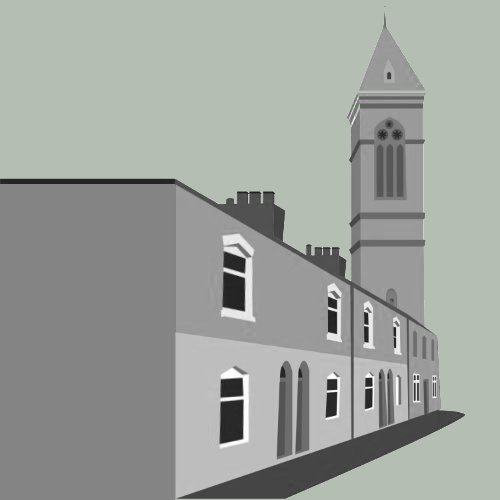
To these streets of narrow terraced housing.

‘Farewell to blue meadows we loved not enough.’
Sir John Betjeman in St Barnabas, Oxford, 1945